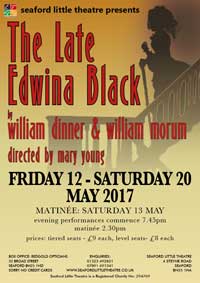
the late edwina black by william dinner & william morum
- Ellen
- Elizabeth Graham
- Henry Martin
- Gregory Black
- Director
- Stage Management Team
- Lighting Design
- Sound Design
- Lighting & Sound
- S
- Continuity
- S
- Set Design
- wardrobe
- programme/Poster design
- Margaret Kennedy
- trish Richings
- Dug Godfrey
- Alan Lade
- Mary Young
- Gill Watson & Phil Jenner
- Gary English
- Alan Lade
- Chris Coleman & Dennis Picott
- Penny Cockell & Barbara Bolton
- Alan Lade
- Debi Lade
- Alan lade
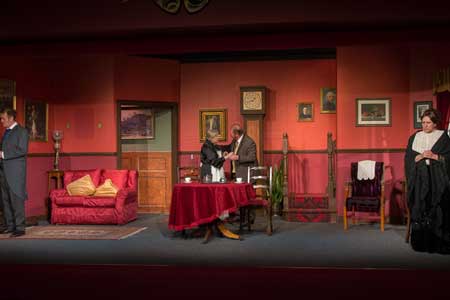
The Late Edwina Black Photo Album
click to view
SEAFORD SCENE Review by Andrea Hargreaves
Seaford Little Theatre's curtains opened to reveal a set that time-travelled us to a stifling late Victorian England, when full mourning had to be worn whether you cared for the person who had died or not. A crimson and tawny dressed stage - yes port really does play a part in this period suspense drama - became the atmospherically conceived parlour in which the cast of four - only one of whom loved the deceased lady of the house - played out this whodunnit.
There is shock when Inpector Martin orders a post mortem, despite the doctor's death certificate. Gregory, the pompous village schoolmaster who has lived a life of luxury on his wife's money, is under suspicion along with his lover and her companion, Elizabeth, with whom he is planning to run away. And not altogether in the clear is adoring housekeeper Ellen.
So who poisoned the poisonous Edwina with arsenic? well that's another thing entirely, but the interest in this play concerns the breakdown in love and trust when one party is all too ready to blame the other in order to save their own skin.
The twisty plot requires many words over two hours, but given that I was gripped from start to finish an extra fifteen minutes would have been even better as there were times when I felt the dialogue was rushed. And this may have had something to do with why the prompter's voice was heard so often.
Willaim Dinner and William Morum wrote this drama in 1949 - not long after that it was made into a film called Obsessed - and were an audience to be transported to the Little Theatre last month they would have felt quite at home with the clipped post war middle-class delivery of the cast.
Unsurprisingly it opens with Ellen, well played by theatre stalwart Margaret Kennedy, having a tidy up and grumpily admitting the detective, portrayed in a refreshing avuncular style by Dug Godfrey. It was good to see Kennedy back on stage after an absence of three years - she directed Nightmare last year and will be directing Neil Simon's comedy Rumours later this year.
Trish Richings as Elizabeth was, like other cast members, a good extractor of humour from the lines to lighten the gloom of the plot. She excflled in her scenes with Gregory, played by the experienced Alan Lade, in which their excitement for a new life together gives way to storm scenes of recrimination. This production, it has to be said, owed much to Lade for not only did he play his part with aplomb but he designed the set and sound, a hypnotic clock ticking ominously throughout and wind chimes at telling momentswhich were received with appreciative 'ooohs'. And Debi Lade found some great costumes.
The drama was ably directed by Mary Young who is as strong with dark pieces as with comedy.