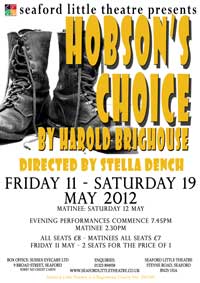
hobson's choice by harold brighouse
- Alice Hobson
- Maggie Hobson
- Vickey Hobson
- Albert Prosser Henry Horatio Hobson
- Mrs Hepworth
Timothy 'Tubby' Wadlow - William Mossop
- Jim Heeler
- Ada Figgins
- Fred Beenstock
- Dr MacFarlane
- Director
- Stage Manager
- Assistant Stage Managers
- Lighting Design
- Lighting & Sound
- S
- Continuity
- Set design
- wardrobe
- S
- programme/Poster design
- Jenny Humphries
Ann Mabey
Lindsey Holledge
Chris Church
Douglas Wragg
Mary Young
Dennis Picott - Roland boorman
- Stephen Newberry
- Wendy Picott
- Peter Barnes
- John Hamilton
- Stella Dench
- Gill Watson
- Ian Baldwin & Brenda Clifford
- Gary English
- Samantha Chapman & Gary English
- Penny Cockell
- Alan Lade
- Helena Bell & Margaret Kennedy
- alan lade
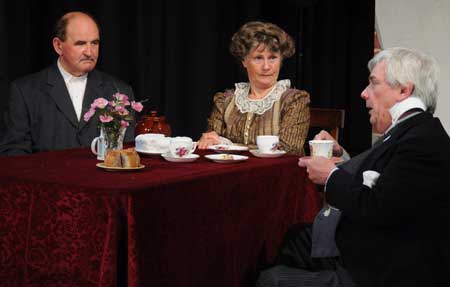
Hobson's Choice Photo Album
click here to view
SEAFORD GAZETTE Review by Derek Watts
When playwrights want to write about sisters they almost always use three of them. Three brothers for a fairytale, three sisters for the stage: just think Chekhov, or the weird ones in ‘Macbeth’ and the ungrateful ones in ‘Lear’. Harold Brighouse followed this pattern for his famous family drama, written in 1915, set in 1880, revived at Seaford in Stella Dench’s cosy production.
It is a measure of how far society has travelled over the century since the play first saw the light of day that its central theme - what Hobson perceives as his daughters’ shocking disrespect - in these days of equality between the sexes, is just terribly dated. What the cantankerous old Salford boot-seller Hobson saw as “uppishness” is no longer hilarious – if it ever was. While Hobson wants his daughters, Alice, Vickey and Maggie, to mind the shop, put his dinner on the table, and to marry who and when he chooses, they want what young girls have always wanted – a husband with prospects. Vickey, played with pert precision by Lindsey Holledge, has her eyes on Freddy Beenstock the son of a respectable corn merchant [charmingly played by Peter Barnes], while Alice [Jenny Humphries] has been seeing Albert Prosser, a young up-and-coming solicitor, played by the promising Chris Church. A clear dysfunction of age relationships rather confused the issue here, but Brighouse’s essential point about the desire for security and social advancement was well made.
Maggie is the eldest of the three, and her careful attention to the books has nearly as much to do with the success of the business as Willie Mossop’s bootmaking genius. Ann Mabey’s Maggie was attractive, forceful and brisk. Roland Boorman’s Willie Mossop, gave a comically touching performance, and though when faced with the prospect of ‘getting wed’, you could see he longed to be anywhere else, his monotone mumbles hint that here is someone who may sound faintly but will not go unheard. His protests however go unheeded, and what he has to learn is that Maggie’s whirlwind courtship is the best thing to come his way. Their closing scene was delicately moving, and in Ann Mabey’s performance we can see in her organising vigour a regard for him that is tender despite her veneer of bossiness.
To be sure, the audience laughed at Douglas Wragg’s buffoonery, as his Hobson descended from boozy bluster into mumbling incoherence. Wragg managed to convey the slow disintegration of Hobson’s grasp on both his daughters and his business, and finally himself. Unable to comprehend the modern ways, he has no choice in the end but to submit meekly to his lot, to be looked after by Maggie in the shop now run by a triumphantly successful Mossop.
In truth, Brighouse’s characterisations outside the main pair are seldom subtle, but offered small but rewarding opportunities for Dennis Picoot as Tubby Wadlow, the loyal cobbler with a nice line in homespun philosophy, Stephen Newberry as one of Hobson’s drinking pals, Mary Young as Mrs. Hepworth, a ‘posh’ customer and John Hamilton as Dr. MacFarlane, who tells Hobson a few home truths as he faces his final decline.
The three sets over the four acts set a challenge for Alan Lade’s set design, elegantly overcome by some precision painting and judicious multi-sided flats.
On the whole, the warmth of the writing and some attractive performances largely offset Brighouse’s out-dated social comment and the audiences went away secure in the knowledge that if we can still laugh at plays like this, then the recession and the eurozone can still be kept at bay.
EVENING ARGUS Review by Tony Flood
A talented Seaford Little Theatre cast shine in Harold Brighouse's Northern comedy Hobson's Choice, featuring a battle of wills between a dictatorial boot shop owner and his three daughters back in 1890.
Charismatic Douglas Wragg makes an excellent debut with Seaford as domineering, tight-fisted widower Hobson, who somehow manages to evoke sympathy despite making his daughters work without pay, appreciation or respect.
Ann Mabey (Maggie), Jenny Humphries (Alice) and Lindsey Holledge (Vickey) are also impressive in the roles of the suppressed daughters.
Wragg and Mabey have some great scenes as Maggie holds her own with her father. But Roland Boorman steals the limelight as the subservient, seemingly slow-witted boot-maker Will Mossop, who is horrified to be told by old maid Maggie that he will be her husband.
Although his performance is in danger of becoming a caricature, he milks the laughs by capturing Will's reluctance, awkwardness and fears. And he skilfully handles Will's transition from downtrodden, mocked employee to confident businessman.
In contrast, Hobson's drunken fall into a cellar puts him in danger of having his reputation tarnished.
Fine direction by Stella Dench ensures that the relationships between the two younger sisters and their suitors, played by the very promising Chris Church and Peter Barnes, are not merely superficial.
Mary Young and John Hamilton excel in two delightful cameo roles - posh customer Mrs Hepworth and Dr MacFarlane - while Dennis Picott, Stephen Newberry and Wendy Picott provide good support. Alan Lade's effective sets help give a dated but amusing play credibility.
SEAFORD SCENE Review by Fran Tegg
Seaford Little Theatre’s production of Hobson’s Choice, directed by Stella Dench was well worth the ticket! An excellent adaptation that was carried admirably by Ann Mabey as Maggie Hobson, the delightful Roland Boorman as Willie Mossop and the humorous Douglas Wragg as Henry Hobson.
This comedy, set in Lancashire, is about wealthy shoe- shop owner Henry Hobson and his three daughters Maggie, Alice (Jenny Humphries) and Vickey (Lindsey Holledge). Struggling with his daughters’ ‘uppishness’, Hobson is advised by Jim Heeler (Stephen Newberry) to have his daughters married however Hobson knows that Maggie, his eldest, is too valuable to his business to lose and declares she is past the marrying age and has been ‘shelved’, In retaliation headstrong Maggie decides she will marry the shy, uneducated but very skilled bootmaker Willie Mossop who will also bring business opportunities.
Maggie sets up a rival shoe-making business with Willie and is soon taking away many of Hobson’s customers. Hobson in the meantime takes to drinking heavily whilst his two daughters are left to run his business but not very well, realising that Maggie had a lot to do with the success of the business. Maggie begins tutoring Willie, encouraging him to develop his confidence and their relationship gains strength, leading to moments of tenderness interspersed with hardened northern humour - the terrified Willie finds comfort sucking his thumb in his bed in the living room, only to be dragged by the ear by Maggie to their wedding bed!
Hobson continues to drink heavily whilst his daughter Alice pursues a courtship with a young solicitor Albert Prosser (Chris Church) and Vickey with Fred Beenstock (Peter Barnes); meanwhile, his business declines further. To top it all, in a drunken stupor Hobson falls through an open cellar door at the Moonrakers’ pub and is sued for trespassing! On falling into despair and realizing that he has been ‘deserted by his daughters’, Dr MacFarlane (John Hamilton) is called to treat his illness. With very amusing exchanges between the two, the doctor diagnoses Hobson with depression and alcoholism and prescribes him a total abstinence from drinking and recommends that he gets Maggie back to save the business.
Maggie is invited by Hobson to tea and returns with Willie who by now is an educated and very confident businessman. Will proposes to Hobson a business partnership on condition that the business be named ‘Mossop and Hobson’. Due to his circumstances Hobson has no choice but to agree and the play ends happily with Maggie and her transformed husband Willie, clearly very much in love... ee bah gum!
A fine cast is completed by Mary Young (Mrs Hepworth), Dennis Picott (Timothy ‘Tubby’ Wadlow) and Wendy Picott (Ada Figgins). A classic play brilliantly performed, with excellent direction by Stella Dench. Full marks too for the costumes used by the cast and for the set designs (Alan Lade).