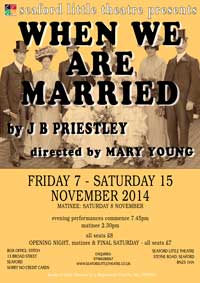
when we are married by j b priestley
- Ruby Birtle
- Gerald Forbes
- Mrs Northrop
- Nancy Holmes
- Fred Dyson
- Henry Ormonroyd
- Alderman Joseph Helliwell
- Maria Helliwell
- Councillor Albert Parker
- Herbert Soppitt
- Clara Soppitt
- Annie Parker
- Lottie Grady
- Rev. Clement Mercer
- Director
- Stage Management
- S
- Lighting Design
- Lighting & Sound
- Continuity
- S
- Set design
- wardrobe
- programme/Poster design
- Katie Hargreaves
- James Collins
- Cathryn Parker
- Katherine Whinn
- Stephen Newberry
- Douglas Wragg
- Roland Boorman
- Ann Mabey
- Dug Godfrey
- Dennis Picott
- Patricia Pape
- Sue Shephard
- Josie Hobbs
- John Gibbins
- mary young
- gill watson, Milli Palmer-Wright and Lori Boul
- Gary English
- Ian Baldwin
- Clare Forshaw & Penny Cockell
- Alan Lade
- Debi Lade
- Mary Young with Alan Lade
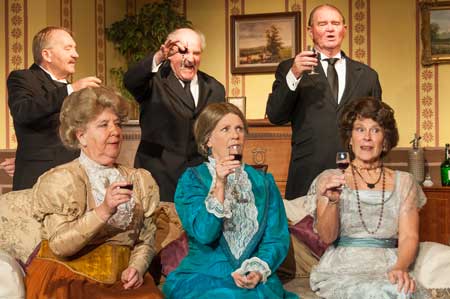
When We Are Married Photo Album
click here to view
SEAFORD GAZETTE. Review by Derek Watts
One of the iconic British playwrights of the last century, J.B. Priestley, a child of the Edwardian era himself, pricked the pomposity of the age in two enormously popular plays, both of which are still performed today. ‘An Inspector Calls’ has a dark undercurrent and a tragic end. The other, ‘When We Are Married’ is more farcical and Mary Young’s production was an enjoyable and affectionate reading of this popular piece.
The premise is simple. Three local couples, including two civic dignitaries and their friend Herbert Soppitt, are found not to have been married twenty-five years ago. This sad fact is revealed by the chapel organist Gerald Forbes, subtly played by James Collins. He is about to be sacked by these pillars of the chapel for being seen ‘walking out’ with a girl. His shock news precipitates the plot. What’s to be done ?
The two Councillors were solidly played by Roland Boorman and Dug Godfrey and Dennis Picott, as Soppitt, was a delightful study in hen-pecked servitude. Soppitt has to do much with not many lines and his face was a picture. Seeking a picture, the local press photographer, a man more interested in port than a portrait, was delightfully played by Douglas Wragg, who falls foul of his boss, the editor of the local paper, played by Stephen Newberry.
The women in the play have the best lines and get the biggest laughs. They all rose to the challenge with aplomb. Patricia Pape, as Clara Soppitt, was a domineering battleaxe to poor Herbert, Ann Mabey captured the pricked pomposity of Maria Helliwell and Sue Shephard made the most of her acerbic asides as Anne Parker.
The fulcrum of the plot, Priestley’s voice of the common man [or woman] is the char Mrs. Northrop. In a memorable portrayal Cathrym Parker stole the show and the scenes with a powerfully blunt rendering of the salt-of-the-earth local gossip.
The situation is compounded by the arrival of Lottie Grady, a Blackpool barmaid, played with panache by Josie Hobbs. She discloses a seaside dalliance some years ago which needs to be hidden and when Rev. Clement Mercer reveals a clerical loophole – something boringly bureaucratic involving a registrar - all is settled and the happy couples can have their anniversary photo taken after all.
Katherine Whinn was a winsome dramatic and real-life fiancée to James Collins’s organist. Katie Hargreaves played the maid, Ruby Birtle.
Alan Lade created a delightful evocation of an Edwardian drawing-room on the awkwardly-shaped stage and the action was deftly orchestrated by Mary Young’s imaginative direction.
Why is Priestley still so popular nearly a century on ? Not only did he write ‘well-made plays’, he captured the traditional British delight in pricking the bubble of the smug and self-satisfied and Seaford’s closing production of the season did just that.
SEAFORD SCENE Review by Andrea Hargreaves
A clever man, that JB Priestley: rather than set this play contemporaneously with its writing in 1938 he went back 30 years, allowing his audience to believe, if they wanted to fool themselves, that he was directing his ironic wit at the Edwardians.The play concerns three couples who were all married on the same day in the same chapel. They have gathered at the Helliwells' home to celebrate their silver anniversary. When it is disclosed that the minister who conducted the service was not qualified for weddings they are horror struck. Whatever will the neighbours think? How will they conceal this 25-year lapse when a nosey cook and nosey newshounds are all too ready to spread gossip? And if they are not married, do they still wish to live in unsatisfactory marriages?
It was good to see some new young faces playing ageappropriate roles. Directer Mary Young never missed a comedic trick, and I can't help wondering if she gave private lessons to Katie Hargreaves, her granddaughter, playing the maid whose opening lines. - a recitation of Bake Off goodies delivered fast and deadpan - establish the smugness of the hosts and their friends. Also making her Seaford debut was Katherine Whinn, pertly playing the amour of chapel organist Gerald Forbes (the able James Collins). It is he who drops the bcmbshell via a letter written by the minister, played with great verve by John Gibbins, another welome newcomer.
Whinn and Collins are in real life, to wed, but we can be sure that they won't be using the Helliwells as role models in a relationship where the pompcus Alderman, crisply played by society stalwart, Roland Boorman, dictates to his meek wife, portrayed by Ann Mabey, nor the Parkers, where Dug Godfrey holds the stage as a self-important windbag dragging Sue Shephard in his wake, nor the Soppitts, where a cowed Dennis Picott is kept under by a formidably dominant Patricia Pape. Priestley would surely have appreciated the self-satisfaction shown by all six in the delightful set pieces staged by Young.
Priestley's supporting characters provide more comedy, and Cathryn Parker as the ccok, who overhears the scandal and threatens to pass it on was wonderful. So too was Douglas Wragg as thie boozy photographer, ably supported by reporter Stephen Newberry. Josie Hobbs brought blowsy loucheness to barmaid Lottie with whom the Alderman has dallied in Blackpool.
All the cast are to be commended for mastering the Yorkshire accent and the gusto with which they played their ro!es, but the greatest honour
belongs to Mary Young
for her direction of this revival, in which,
incidentally, she played
Maria Helliwell in 1985.
As the photographer's flashgun captures in freeze frame
the recreated wedding picture of the three couples marking 25 years of harnessed-in-wedlock respectability
- a registrar was present after all - and Katie Hargreaves
drops her tray. we could leave the theatre glad, in the 21st century, to be free of such constraints.