the wooden dish by edmund morris

- Lon (Pop) Dennison
- Clara Dennison
- Bessie Bockser
- Ed Mason
- Susan Dennison
- Sam Yeager
- Glenn Dennison
- Floyd Dennison
- James Forsythe
- Janey Stewart
- Director
- Stage Managers
- ASM
- Lighting Design
- Sound Design
- Lighting & Sound
- Continuity
- Set design
- wardrobe
- programme/Poster design
- John Hamilton
- Sue Shephard
- Angie Wright
- Pete Linsdell
- Emily Barlow
- David Parton
- Dennis Picott
- Alan Lade
- Peter Barnes
- Clare Forshaw
- David Parton
- Ray & Debbie Cox
- Milli Palmer-Wright
- Gary English
- Alan Lade
- Ian Baldwin
- Penny Cockell
- Alan Lade
- Helena Bell, & the cast
- Alan lade
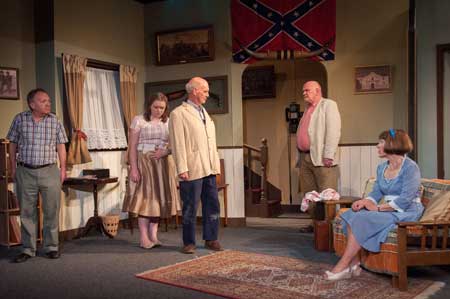
Wooden Dish Photo Album
click here to view
SEAFORD GAZETTE Review by Derek Watts
Edmund Morris’s The Wooden Dish is set in time (1955) and atmosphere between the literary, political work of Arthur Miller and the lyrical passion of Tennessee Williams. Squeezed between these two giants of twentieth century American drama, the play is now largely forgotten but as David Parton’s fine production at Seaford showed, it is an interesting play which merits revival.
Though set in Texas, it has a universal theme: it concerns the cold war between a housewife (Clara) and her father-in-law, a tough, asthmatic old wreck. John Hamilton, as the cantankerous curmudgeon, brought a brilliant acidity to a demanding role. He breaks things in the house every day and protests that she serves his food in an unbreakable wooden dish. Clara is at the end of her tether and wants to put him in a home. He, however, just wants to sit in the yard, dream of the Alamo and play checkers with his neighbour, Sam (a sympathetic performance from David Parton). His son, Glenn, is torn between conflicting loyalties and while Dennis Picott brought sincerity to the role, he never quite touched the heights of passion which the intense family rows demanded. These tensions escalate when his elder brother Floyd arrives from Chicago to stump up the money for Pop’s rest home. Here, Alan Lade portrayed a raw irritation, tossed helplessly from one loyalty to another, between pragmatism and moral duty. Clara (a committed and intelligent performance from Sue Shephard) has passion and is desperate enough for anything—even an attempted love affair with a younger man (played with power and commitment by Pete Linsdell) and when Pop finally gives up the fight to remain in his son's home, it is left to his granddaughter, Susan, played with charming sensibility by Emily Barlow, to see with the compassion that only youth can feel for age, the true tragedy of his going.
There are sub-plots rumbling beneath the raw dynamics – Angie Wright had a delightful cameo as Bessie, Floyd’s old flame, Clare Forshaw made a telling contribution as Janey, Susan’ best friend and Peter Barnes was suitably smooth and persuasive as Forsythe, the rest home manager.
The set as usual did what it needed to do in a difficult space and the 1950s music was carefully chosen.
Parton’s production was pure theatre, illustrating the kind of tragedy that visits too many families because the middle generation doesn't know how to cope with the older generation and the drama of an old man's rage and fear, the agonising and divided loyalties were so real that I feel sure many members of the audience identified with these universal themes.
SEAFORD SCENE Review by Andrea Hargreaves
This being a town much favoured by the silver generation, the audience watching Edmund Morris' play was, it has to be said, on the maturer side of 50. For many of the younger ones in Seaford Little Theatre that evening the question of what to do with Mum or Dad might have begun to cause concern. For the older ones they were probably thankful that good health had kept them out of old people's homes and able to see such a pertinent production as this.
Set in 1955, it is about a middle-aged woman who is fed up with looking after her increasingly frail father-in-law in their house in Texas
that is shared by her husband, daughter and a lodger. When she persuades her husband and his visiting brother to cough up to keep Pop in what he calls the poor farm, her spouse has second thoughts and her daughter is horrified.
All 10 of the cast played with Texan-accented assurance, but the standout success had to be John Hamilton as Pop, still in possession of his faculties but grown clumsy with failing eyesight and age, He excelled in a small part in the recent Portrait of Murder; let's see more. In dialogue with Susan, the daughter, played with fire and empathy by Emily Barlow, he portrayed the betrayed Pop with moving dignity. Sue Shephard as Clara, the wife, was taking the part played by President Valerie Shepherd in 1968, a time when retirement homes, good and, um, not so good, were springing up all over town to cater for a changing society. I didn't see that production — although Valerie, who acted and directed many for the society, remembers it as her favourite but I am not sure she would have approved of Clara's girlish hairbands. However, as a device to portray her desperate attempt
to escape a joyless life by running away with the younger lodger, it had validity. Alan Lade lived up to his reputation in the role of the visiting brother and should be congratulated for the three-part set that worked cohesively on the small stage and was rich with period detail. As Clara's husband, Dennis Picott had an interesting role, one that required him to go from weak to suddenly strong and back to weak when the thwarted Clara dusted off her suitcase. It was good to see Peter Barnes brought to the front from his usual position backstage, playing the slightly creepy home owner with life-changing contract to sign, And Angie Wright as neighbour
Bessie brought some humour to the piece and made you feel the heat of Texas.